
EAC CERTIFICATE AND EAC DECLARATION
DIFFERENCE BETWEEN CC AND DC

The EAC certificate officially confirms that products comply with the GOST technical directives and the technical regulations of the Customs Union member countries. Products whose compliance with technical regulations has been confirmed by the EAC certificate can be freely transported and sold in the member states of the Eurasian Economic Union.
THERE ARE 2 TYPES OF EAC CERTIFICATES
Serial Validity (maximum 5 years)
The certification process for issuing a serially valid certificate requires an analysis of the production sites' output by accredited experts.
If there are multiple production sites, it will be necessary to carry out the relevant inspections before the EAC Certificate expires.
Furthermore, it will be necessary to test the samples at accredited laboratories within the Customs Union.
If the samples are too large to ship, testing can be carried out at the production site by an accredited technician.
If the tests are successful, the Certification Body enters all the data into the single federal register and prints the EAC Certificate.
Annual inspections of production sites are required by the Certification Body that previously issued the EAC certificate to verify compliance.
The certificate is printed on an official form, which features several forgery-proof elements and is authenticated by the signature and seal of an accredited body.
Single Order Validity
The EAC Certificate for a single order is issued for a defined quantity of products.
Unlike the previous Certification Process, issuing the Single Order Certificate only requires testing of samples.
Therefore, no inspection visits or production analyses are foreseen.
For a single-order certificate, the following must be specified: the contract between the exporting and importing companies, the invoice, and the serial numbers of the items to be certified. This certificate is therefore valid only for shipments related to a specific order and the corresponding invoice.

The EAC Declaration is an official document confirming, by the manufacturer, importer, or authorized representative, the conformity of products with the minimum requirements of the technical regulations of the Customs Union.
Unlike the certificate, the EAC declaration is issued by the manufacturer or importer themselves. All necessary tests and analyses are performed by the manufacturer or, in some cases, by an accredited external laboratory. The EAC declaration is printed on a standard A4 sheet of paper.
The task of registering the EAC Declaration in the single register will be the responsibility of the manufacturer's Declarating Body.
THERE ARE 2 TYPES OF EAC DECLARATIONS

Serial Validity
(maximum 5 years)
Single Order Validity
EAC Certification Schemes
| Scheme | Serial Validity | Single Order Validity | Accredited Laboratory | NON-Accredited Laboratory | Production Analysis | Annual inspection |
|---|---|---|---|---|---|---|
| 1c | x | x | x | x | ||
| 2c | x | x | x | x | ||
| 3c | x | x | ||||
| 4c | x | x | ||||
| 5c | x | x | x | x | ||
| 6c | x | x | x | x | ||
| 7c | x | x | x | x | ||
| 8c | x | x | x | x | ||
| 9c | x | x |
We are accredited in TR CU regulations of the Customs Union
TR CU 004/2011 “On the safety of low-voltage equipment”
The low voltage equipment covered by this technical regulation
of the Customs Union include electrical equipment with a nominal voltage of 50 to 1000 V (inclusive) AC and 75 to 1500 V (inclusive) DC.
This regulation is often linked to TR CU 020/2011, also known as “EMC”, as most electrical products, when operating under voltage, produce electromagnetic fields that could cause electromagnetic interference with other devices.
Depending on the intended use and customs codes, the type of document that must be issued is identified: EAC Certificate or EAC Declaration.
Products, which operate under voltage and are intended for daily use, generally fall under the EAC Certificate of Conformity (schemes 1c, 3c, 4c).
For products intended for the industrial sector, the EAC Declaration is generally issued.
The declaration scheme is chosen by the representative or importer.
Right away the link for the complete regulation.
TR CU 007/2011 On the safety of products intended for children and adolescents
TR CU 007/2011 applies to products intended for children under 14 years of age, including clothing and footwear, strollers and bicycles, books, dishes, hygiene products and others.
If the product is intended for use by children under 3 years of age, a Health and Hygiene Certificate (СГР) may also be required.
Subject to EAC declaration according to TR CU 007/2011:
The following product groups are subject to conformity assessment in the form of an EAC declaration
- clothing for children from 1 year old
- Winter fur and fabric hat for children aged 1 year and up
- wool shoes
- books and magazines
The EAC declaration is valid for up to 5 years if the test reports are issued by an accredited testing laboratory or up to 3 years in case of conformity assessment based on internal company tests.
Subject to EAC certification according to TR CU 007/2011:
The following products are subject to conformity assessment in the form of EAC certification:
- rubber baby hygiene products
- plastic and metal baby hygiene products
- bed linen
- intimate
- socks
- clothing
- headgear for children up to 1 year old
- outerwear for children up to 1 year old
- Fur clothing and headwear for children up to 1 year old
- footwear, other than wool footwear
- strollers
- bicycles
The EAC certificate is valid for a maximum of 5 years.
TR CU 007/2011 does not apply to:
- medical products
- baby food
- perfumes and cosmetics
- sports items and equipment
- teaching materials, textbooks, etc.
- toys and board games
- children's furniture
- custom-made products
Right away the link for the complete regulation.
TR CU 009/2011 “On the safety of perfumes and cosmetics
Perfumery and cosmetic products placed on the market in EAC countries must comply with the provisions of the Technical Regulation of the Customs Union TR CU 009/2011 “On the safety of perfumes and cosmetics”: let's briefly see what it provides.
All perfumery and cosmetic products intended for external use, intended to beautify, alter the appearance, color, or fragrance of body parts, must be certified according to this technical regulation. Products intended to be ingested, inhaled, injected, or implanted do not fall under this category.
To certify products, samples must be sent to an accredited laboratory within the Customs Union, where the composition will be verified to comply with the TR CU parameters. Packaging and labeling must also be compliant.
Some products for cosmetic use but containing more aggressive chemical ingredients require a different type of certificate — the SGR (–>link), state health and hygiene certificate. Examples include: hair dyes and bleaches, tanning products, oral hygiene products that whiten or contain fluoride, etc.
Right away the link for the complete regulation.
TR CU 010/2011 On the safety of machinery and equipment
TR CU 010/2011 regulates safety standards for machinery and equipment within the territories of the Eurasian Economic Union, which includes Russia, Belarus, Kazakhstan, Armenia, and Kyrgyzstan. Compared to previous directives, these are more closely aligned with their European counterparts, from which they sometimes differ very little.
This regulation provides all the indications to ensure the safety of machinery and equipment throughout their entire life cycle, from the design phase to disposal.
If the machinery or equipment is intended for hazardous areas, so-called “hazardous production facilities (in Russian: Опасный производственный объект (ОПО)”), the EAC TR CU 010/2011 Declaration will be issued according to scheme 5d.
It will be essential to test all product types, so as to obtain Certificates of Conformity for each type.
Tests must be carried out at accredited laboratories registered within the Customs Union.
Right away the link for the complete regulation.
TR CU 012/2011 - (RUSSIAN ATEX) “On the safety of equipment for potentially explosive atmospheres”
Technical regulation TR CU 012/2011 contains the standards and directives for products and equipment intended for explosive environments. All products with the ATEX marking are subject to TR CU 012 certification. For the EAC market, the ATEX product certification process is essential and mandatory and occurs as follows:
- First, you need to identify the product category, its customs code, and the ATEX marking to identify the GOST regulation it is subject to. You will then need to determine whether you intend to request serial certification (valid for 1 to 5 years) or project-specific certification (for a specific batch or a single unit).
For TR CU 012, the EAC Certificate, not the EAC Declaration, is always issued. The product is ALWAYS subject to specific tests/inspections in order to obtain the EAC TR CU 012/2011 Certification. Furthermore, it is essential that the latter be issued by a Certifying Body with state accreditation—not only for this technical regulation 012/2011, but also for the customs code of the product for which the certificate is issued. Furthermore, the certificate can only be issued based on inspections/tests at one of the laboratories accredited for TR CU 012/2011—and even in this case, the laboratory must have the customs code and type of product it can certify in its accreditation field. This specifies that the laboratory has the appropriate facilities and tools to perform the mandatory tests to ensure product safety in potentially explosive atmospheres.
The certification process takes approximately 2-3 months and the necessary steps are as follows:
• Make the request for certification by filling out the questionnaire in which you must indicate:
- product type
- ATEX marking
- list of ATEX components if present
- customs code
- attach the technical drawing and, if available, the user manual
• Once we have obtained this data, our technical experts will process the request in approximately 2-4 working days and you will be provided with the commercial offer.
• Once the offer has been confirmed, the following technical documentation must be prepared in Russian:
- Technical Passport
- ATEX User Manual
- Fire risk analysis
- Translation and list of essential documentation to be collected for the technical file
• Once the technical documentation has been prepared, it is possible to carry out product testing at the accredited laboratory in Russia or at the customer's premises (in this case only if the required GOST regulations allow it).
- Negative test/acceptance – a negative test report will be issued, which prevents the issuance of the EAC TR CU 012 certificate. In this case, any engineering non-conformities will need to be reviewed and, once the issue has been resolved, the test will be carried out again.
- Positive test/acceptance – EAC TR CU 012 Certificate issued after approximately 4 weeks.
• For EAC TR CU 012 certification based on a job order (i.e., certification of a batch or a single unit), it will be essential to provide the supply contract (only the first and last pages of the contract, including the number, contract date, and signatures with stamps). Furthermore, it will be necessary to provide the section specifying the item to be certified and its quantity, if applicable; along with this, the pro forma invoice or packing list will also be required. The contract must be between the Customs Union member country and the supplier.
Right away the link for the complete regulation.
TR CU 017/2011 On the safety of light industry products
Technical Regulation TR CU 017/2011 “On the safety of light industry products” refers to the conformity requirements for light industry products: clothing, footwear and textiles.
Each product must undergo testing protocols in laboratories within the EAC Customs Union; the procedure is established primarily based on the product type and material composition.
The following production categories fall under this technical regulation:
- clothes
- footwear
- fabrics
- carpets and upholstery fabrics
- fur and leather garments
- hats, scarves and shawls
- bed linen, kitchen linen and bathroom linen
Most products fall under the Declaration of Conformity requirement; however, all garments that come into direct contact with the skin (e.g., underwear, swimwear), and bed linen fall under the Certificate of Conformity requirement.
Products certified according to TR CU 017/2011 must bear the EAC mark on the product, its label, its packaging, or its package insert. This documentation must also include the following information—in Russian or the language of the EAC country of production:
- Product Name
- Country of production
- Manufacturer or authorized representative
- address of the manufacturer or authorized representative
- cut
- list of materials in %
- trademark
- EAC
- Manufacturer's warranty where required
- production date
- Delivery No.
Furthermore, for clothing and fabrics it will be essential to indicate:
- % outer layer material list
- model
- symbols and instructions for product care
The footwear will instead require:
- model and size
- Material list in % of upper, lining and sole
- product care instructions
For fur garments:
- type of fur and workmanship
- symbols and instructions for product care
For leather garments:
- % outer layer material list
- model
- product care instructions
The TR CU 017/2011 conformity certification is valid for a maximum of 5 years and is issued on the basis of test protocols no older than 3 years from the date of issue of the certification itself.
Right away the link for the complete regulation.
TR CU 020/2011 On electromagnetic compatibility
The Technical Regulation of the Customs Union EAC TR CU 020/2011 On electromagnetic compatibility establishes the requirements that devices must meet in order not to cause and not be subjected to electromagnetic disturbances.
Please note, however, that these technical regulations do not apply to the use of radio frequencies, which are subject exclusively to the national legislation of the individual EAC countries.
TR CU 020/2011 is the only reference standard for electromagnetic compatibility in EAC countries.
All devices capable of generating electromagnetic fields fall under the EAC TR CU 020 declaration of conformity. The following products are excluded from this category and instead fall under the EAC TR CU 020 certificate of conformity:
- home appliances
- personal data processing machines
- devices that can be connected to personal data processing machines
- electronic instruments (including musical instruments)
Technical regulation TR CU 020 is often combined with other TR CUs, such as TR CU 004 on the safety of low-voltage equipment or TR CU 010 on the safety of machinery and equipment.
The TR CU 020/2011 certification is issued with a maximum validity of 5 years.
Right away the link for the complete regulation.
TR CU 025/2012 On furniture safety
Technical Regulation 025/2012 “On the safety of furniture” refers to the requirements for furniture to be placed on the market of the EAC Customs Union.
The parameters considered to evaluate the conformity of the products are the following:
- mechanical safety
- chemical safety
- hygienic safety
- fire safety
- electrical safety
Tests will be conducted primarily considering the furniture frame materials and upholstery materials. For furniture with built-in appliances, relevant conformity certificates must be provided (e.g., for TR CU 004/2011 "On the safety of low-voltage equipment" or TR CU 020/2011 "On electromagnetic compatibility").
All furnishing accessories are subject to the EAC TR CU 025/2012 declaration of conformity, with the exception of children's furniture, school furniture and nursery furniture – products which instead fall under the EAC TR CU 025/2012 certificate of conformity.
The maximum validity period of the EAC TR CU 025/2012 certification is 5 years.
Right away the link for the complete regulation.
TR CU 032/2013 “On the safety of pressure equipment”
This regulation applies to equipment operating under pressure.
Generally, the products falling under the TR CU 032/2013 regulation are:
- Pipes and fittings for liquids, gases and vapours of various media with a maximum allowable pressure exceeding 0.05 MPa and a nominal diameter exceeding 25 mm
- Containers for liquids and gases with an equipment pressure exceeding 0.05 MPa
- Boilers for the production of hot water with a temperature above 110 degrees and for the production of steam with an excess pressure above 0.05 MPa
- Components and parts subject to pressure
According to the technical regulation TR CU 032/2013 all pressure equipment must be designed and manufactured in such a way that specific risks can be excluded.
The equipment falling under the TR CU 032/2013 regulation is divided into categories:
1) Category I and II = The product will fall under the declaration of conformity;
2) Category III and IV = The product will fall under the certificate of conformity;
Once the type of conformity document has been established, the type of certification/declaration scheme to follow to obtain the document must also be established.
Right away the link for the complete regulation.
TR CU 037/2016 On restrictions on the use of certain hazardous substances in electrical and electronic equipment
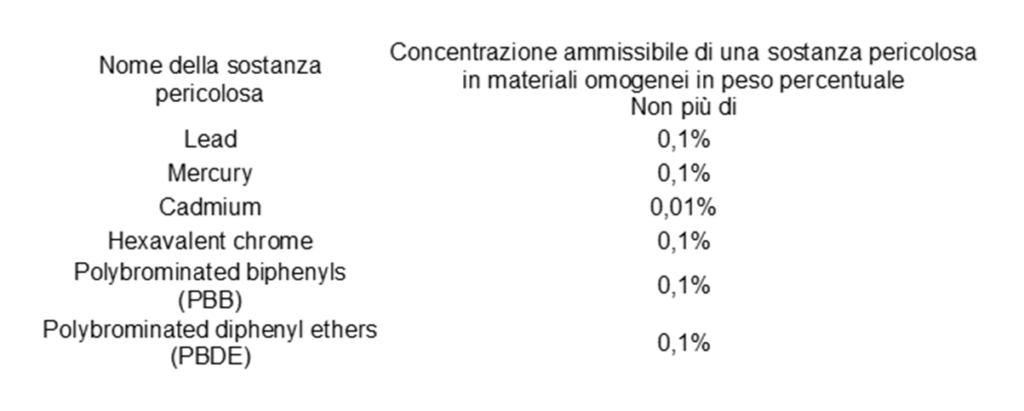
Regulation TR CU 037/2016 contains safety requirements for the concentration of certain hazardous substances in electrical and electronic equipment for the protection of life, health, and the environment. Furthermore, it serves to prevent misleading consumers. The technical regulation specifies the maximum percentage of hazardous substances that a component may contain (see table).
The EAC TR CU 037/2016 Declaration can be issued based on the test protocols used to declare the product compliant with the European ROHS Directive.
If you do not have the test protocols, you will need to send the samples to an accredited laboratory registered in the Customs Union, where the relevant tests will be carried out.
Right away the link for the complete regulation.
TR CU 043/2017 "On the requirements for fire safety and fire extinguishing devices
Starting January 1, 2020, there will be two types of fire safety certificates in Russia:
- Fire Safety Certificate
Federal Law No. 123-F, “Technical Regulations on Fire Safety”
- EAC Certificate TR CU 043/2017 “On requirements for fire safety and fire-fighting equipment”
The Technical Regulation applies to firefighting equipment marketed within the Eurasian Economic Union. Fire safety and fire extinguishing equipment is subject to certification or a declaration of conformity. The Technical Regulation is designed to protect human life and/or health, property, and the environment from fires, as well as to prevent misleading consumers. Product categories to which Technical Regulation TR CU 043 applies include, for example:
- Fire-fighting material
- Fire fighting equipment
- Fire fighting equipment components, such as sensors, control panels, power supplies
- Technical devices that function as parts of fire protection systems, such as valves, compensators and filters
- PPE and fire-fighting clothing
- Evacuation devices and tools
- Fixtures with a fire-retardant rating, such as doors and windows
- Other special categories
Right away the link for the complete regulation.